
To Tom Schroeder, every bee is a work of art. His own words, backed up with hundreds of photos in his camera roll from the prairies and woods of Kansas City WildLands. With more than two decades of volunteering with the group, he’s become a bee enthusiast– but not an expert, he’ll clarify.
“We’re the ones who are invading the bees’ territory, and so we need to respect and take care of them,” Schroeder said. “It’s fascinating to look at their structures. Just look at them. And see how unique each one is? Many of them have very beautiful colors.” Missouri and Kansas are home to approximately 400 different bee species, according to state officials and conservation groups.
Bees are essential for pollination, which has a direct impact on food supply and overall plant diversity. The fuzzy bodies of bees are quite literally “built for pollination” by picking up and carrying pollen, said Tamra Reall, a field specialist in horticulture with the University of Missouri Extension.
“Insects can survive without us,” Reall said. “But we actually can’t survive without them.”
However, the populations of all bee species are declining.
University reported that commercial beekeepers in the United States have recorded honey bee colony loss rates averaging 30% each winter since 2006, as compared to historical loss rates of 10% to 15%.
According to the U.S. Environmental Protection Agency, habitat loss, the spread of diseases and parasites, misuse of pesticides, and climate change all contribute to the problem.
Misplaced pride and joy
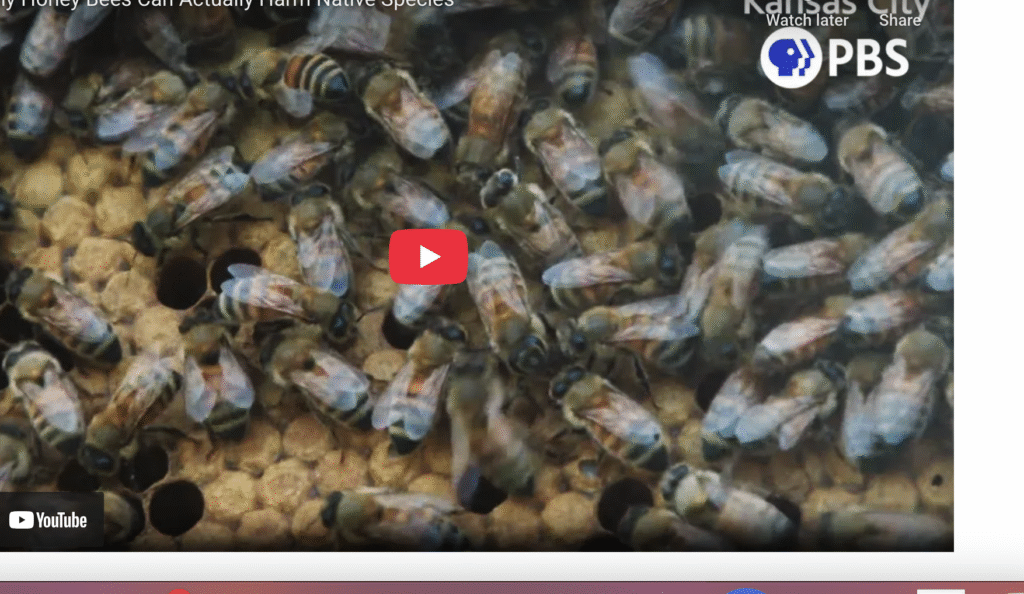
To a large extent, the honeybee is the poster child of the “save the bee” movement — for better or for worse.
Since European settlers introduced honeybees to the United States in the 17th century, they’ve played an active role as crop pollinators, especially in agricultural settings where they’re managed for crops.
Individual conservationists have also popularized backyard beekeeping as a way to preserve bees.
A Facebook page for Missourians interested in beekeeping has more than 19,000 followers and continues to grow. Conversations focus on maintaining hives in both rural areas and urban spots.
“Beekeeping can be a really rewarding way to connect with our food system and the environment,” Reall said. “But it’s not as simple as setting up a hive … if a honey beehive is not managed properly, it can actually become a source of problems.”
Mismanagement can result in parasites, like mites, infiltrating hives. Along with potentially transmitting diseases to wild bee populations, mites tend to feed on the bees in the hive.
Even if hives are well-managed in urban areas, honeybees can cause other potential problems.
“They’re a really charismatic, loved species,” said Hunter Moore, a restoration ecologist and Kansas City WildLands Program Manager with Bridging the Gap. “So I don’t think they’ll ever be officially labeled as this, but from my work and from my perspective, they’re almost like an invasive species.”
A single honeybee hive can hold up to 60,000 bees in the summer, and they can quickly outcompete native species when journeying miles to forage for pollen, according to Reall.
Read Entire Article HERE.
Learn how bees impact crops and food and how you can help! Authored by Abigail Landwehr. Originally published Published September 25th, 2025 at 6:00 AM.


